psychiatry + Architecture

SOTERIA BERLIN - HAUS JOSEF / thinkbuild architecture
WHAT IS PSYCHIATRIC ARCHITECTURE?
It is well established that carefully designed, stimulating and nurturing environments can have a positive impact on mental health. Improving the atmospheric quality of institutional spaces in psychiatry not only promotes well-being for patients, but also offers significant comfort to other users of these buildings. Professionals, families, friends, and visitors also benefit when treatment takes place in spaces customised to meet the needs of all users.
Great architecture in psychiatric hospitals can lead to improved efficiency in service delivery, higher quality of work life, and more sustainable and positive healing experiences.
The evidence is specific, not general. Ward design has been shown to reduce aggressive behaviour and the use of restraint; noise and acoustic conditions affect physiological recovery; the configuration of social space measurably shapes patient satisfaction. The bibliography below collects some of the sources our projects draw on.
thinkbuild examples: Rivers Hospital, Norwich, (UK), Soteria Berlin, and others…

THERAPeutic SPACE
thinkbuild collaborates with your existing team. In this way, we provide interdisciplinary consulting which aims to create and maintain environments which can directly support therapeutic goals and methods on all scales. We strongly believe that architecture and spatial design are important components of any successful therapeutic model.
Our approach facilitates an enriched understanding of the function of architecture in hospital settings by focusing attention on detailed aspects of the atmosphere in support of healing.
Spirit, play, diversity and randomness are given the opportunity to unfold and contribute to our projects, providing depth and character not always seen in institutional spaces.
ACTIVE ATMOSPHERE
thinkbuild works as a plug-in consultancy strengthening traditional design and client teams, focussing on and seeking synergy in the overlap between the design and provision of spaces and the design and provision of mental health care. In so doing, new, integrated and interdisciplinary models have been developed and are continually being tested and optimised.
Through the careful examination of the relationship between physical space, the human psyche and the intangibles of atmosphere or milieu - we design and advise our clients in the creation of psychiatric facilities. This is what we call active atmosphere.
When properly configured, this type of tuned (or active) atmosphere is perceived to be more home-like, generating a comforting and active milieu.
CONSENSUS DESIGN
thinkbuild deploys fundamental design elements such as light, form, colour, materials and architectural narrative. We develop and deploy bespoke spatial therapeutic strategies to support clinical methods in use by mental health professionals on an international scale.
Our method is based on the conviction that great architecture can only be created through close cooperation between those creating the space and those inhabiting the space. By thinking across boundaries, we are able to draw knowledge from many fields of expertise, to create and maintain an open dialogue throughout project phases.
thinkbuild examples:
soteria 2, klinikum wahrendorff prototypen

HOME-LIKE
thinkbuild shares a vision of humanising vital mental health care institutions by striking a balance between familiarity and complexity in design, aiming to provide orientation, character, and welcoming atmospheres. We invite healthcare professionals, administrators and experienced patients into the design process – and designers into the healing process. A joint, consensus-seeking and co-educative journey which produces remarkable results.
Psychiatric
thinkbuild bases its work on consensus-seeking workshops to enable diverse stakeholder groups to develop common understandings around the core concepts in the specific context of each project. We prioritise the unique characteristics of psychiatric space, addressing issues such as safety in recognition of differing therapeutic concepts in order to enable and maintain interdisciplinary dialogue throughout project phases.
Environments
thinkbuild offers proven consensus design methods to create finely tuned, integrated environments that can revitalise existing critical social infrastructures or help create important landmarks for new projects. We invite healthcare professionals, administrators, and experienced patients into the design process – and designers into the healing process – in a collaborative consensus-based and co-educational approach.
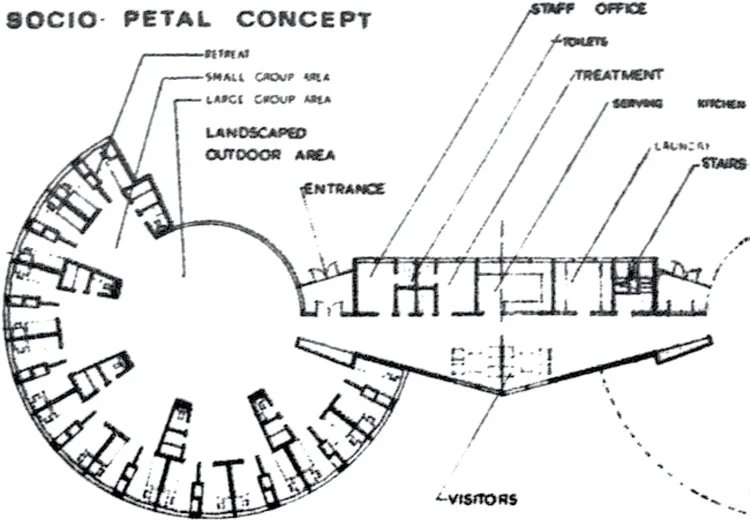
ASPIRATIONAL BIBLIOGRAPHY
Here you will find a few texts and other sources which we have found inspirational and have provided key evidence for our projects. This is an aspirational resource and will be amended and perhaps commented as time allows. At left, a “Draft of socio-petal design” by Kiyoshi (Joe) Izumi (1965).
Awenat YF, Peters S, Gooding PA, Pratt D, Huggett C, Harris K, et al. (2019) Qualitative analysis of ward staff experiences during research of a novel suicide-prevention psychological therapy for psychiatric inpatients: Understanding the barriers and facilitators. https://journals.plos.org/plosone/article?id=10.1371/journal.pone.0222482
Baldwin S. Effects of furniture rearrangement on the atmosphere of wards in a maximum-security hospital. Hospital and Community Psychiatry,Washington 1985; 36(5): 525–528.
Bickley H, et al. (2013) Suicide within two weeks of discharge from psychiatric inpatient care: a case-control study. Psychiatr Serv 64(7):653-9. doi: 10.1176/appi.ps.201200026.
Blomkvist V, Eriksen CA, Theorell T, Ulrich R, Rasmanis G. (2005) Acoustics and psychosocial environment in intensive coronary care. Occupational and Environmental Medicine 62
Bowers L, James K, Quirk A, Simpson A, Stewart D, Hodsoll J. (2015) Reducing conflict and containment rates on acute psychiatric wards: the Safewards cluster randomised controlled trial. Int J Nurs Stud 52: 1412–22
Day C, Parnell R. Consensus Design, London: Routledge, (2002) doi: 10.4324/9780080502885
Daykin N, Byrne E, Soteriou T et al. (2008) The impact of art, design and environment in mental healthcare: a systematic review o fthe literature. J R Soc Promot Health 128: 85–94.
Francis S,Willis J, Garvey A, (2003) King’s Fund. NHS Estates. Department of Health. Evaluation of the King’s Fund’s enhancing the healing environment programme. London: The Stationery Office, 2003
Gibson, J. J., The Senses Considered as Perceptual Systems. London: Allen and Unwin, (1966).
Gibson, J. J. "The Theory of Affordances,” Chapter 8 in The Ecological Approach to Visual Perception. Boston: Houghton Mifflin, (1979)., pp. 127-137.
Hancock, Herbie. (1973) Watermelon Man from the Album Head Hunters https://www.youtube.com/watch?v=i-hAJcXqYms
HM Government (2019) Preventing suicide in England: Fourth progress report of the cross-government outcomes strategy to save lives; published Jan 2019
Jovanović, N., Campbell, J., & Priebe, S. (2019). How to design psychiatric facilities to foster positive social interaction – a systematic review. European Psychiatry, 60,49–62. doi: 10.1016/j.eurpsy.2019.04.005.
Jovanović N, Miglietta E, Podlesek A, Malekzadeh A, Lasalvia A, Campbell J, Priebe S (2020). Impact of the hospital built environment on treatment satisfaction of psychiatric in-patients. Psychological Medicine 1–12. https://doi.org/ 10.1017/ S0033291720003815
Kahan, Fannie. Brains and Bricks: The History of the Yorkton Psychiatric Centre. Regina, Sask. (Canada) : White Cross Publications, (1965).
Kincaid C, Peacock JR.(2003)The effect of a wall mural on decreasing four types of door-testing behaviours. Journalof Applied Gerontology 22(1): 76–88
Moran J. (1978) An alternative to constant observation: the Behavioral Check List. Perspect Psychiatr Care 144: 114–7
Nawaz RF, Reen G, Bloodworth N, Maughan D, Vincent C. (2021) Interventions to reduce self-harm on in-patient wards: systematic review. BJPsych Open. 2021 Apr 16;7(3):e80. doi: 10.1192/bjo.2021.41.
Passini R, Rainville C, Marchand N, Joanette Y. (1998) Wayfnding and dementia: Some research findings and a new look at design. Journal of Architectural and Planning Research 15(2): 133–151.
Sakinofsky I. (2014) Preventing suicide among inpatients. Can J Psychiatry 59(3):131-40. doi: 10.1177/070674371405900304
Staricoff R, Loppert S. (2003) Integrating the arts into healthcare: can we affect clinical outcomes? 2003, p.63–79.
Ulrich RS, Simons RF, Losito BD, Fiorito E. (1991) Stress recovery during exposure to natural and urban environments. Journal of Environmental Psychology 11(3): 201–230.
Ulrich R, Bogren L, Gardiner S, Lundin S. (2018) Psychiatric ward design can reduce aggressive behavior. Journal of Environmental Psychology (57): 53-66 doi: 10.1016/j.jenvp.2018.05.002